


Fitness coach in Geneva: science at the service of your health
|
|
Time to read 10 min
Home services - Geneva
Shop / Boutique
Wear / Vêtements
Athomic Essentials
|
|
Time to read 10 min
Everyone knows that moving is good for your health.
But moving better? That's another story.
Between "miracle routines" on TikTok, trending challenges, and improvised Sunday sessions, the body often becomes a testing ground... sometimes risky.
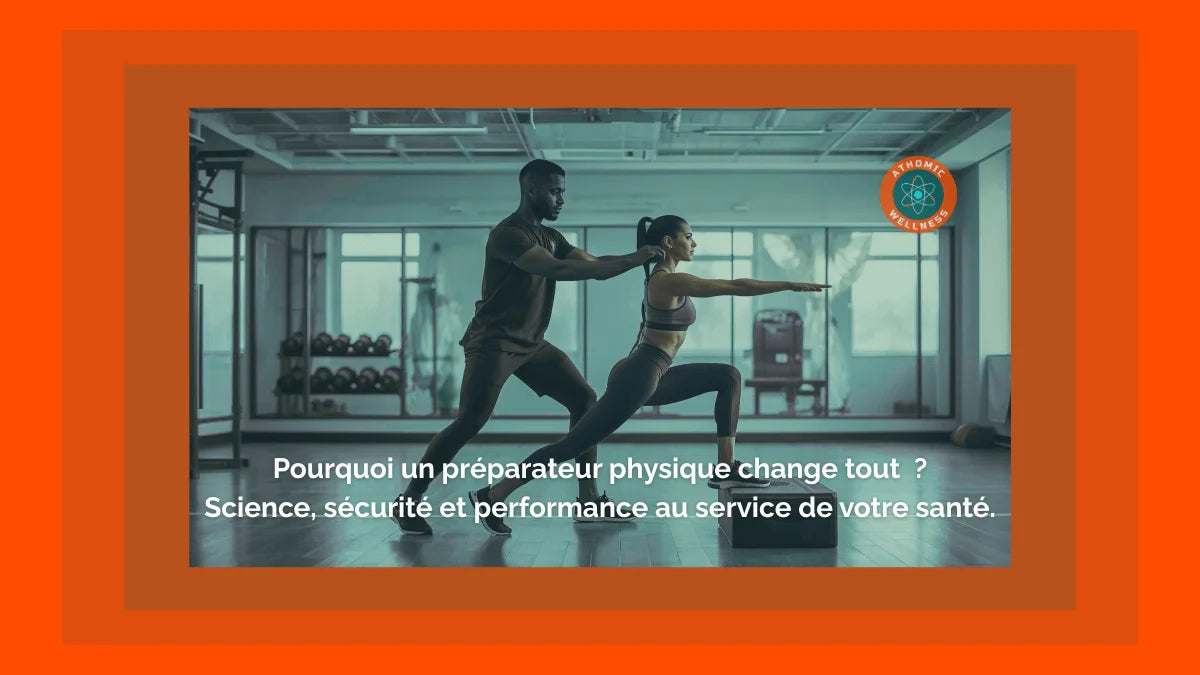
This is where the modern physical trainer comes in—a professional trained to transform movement into a tool for health, longevity, and balance.
At Athomic Wellness, we view the body as an integrated system, where every movement has repercussions on performance, recovery, and even mental well-being.
The coach's role is therefore no longer just to motivate, but to measure, analyze, and adjust: load, posture, asymmetries, nervous fatigue, motivation, etc.
Their goal? To create training that is not only effective today but sustainable over time—training that strengthens without wearing out.
The personal training of tomorrow relies on scientific data, functional tests, and personalization.
It's a work of precision: you don't improvise a plan, you build it.
And in this equation, safety, motivation, and enjoyment are not bonuses, but foundations.
In this article, we will explore how structured, scientific, and human support can positively influence your health—and why a physical trainer is often the key to this lasting transformation.
The modern physical trainer is no longer just a coach: they are a movement professional, trained in physiology, biomechanics, and the neuroscience of performance.
Their role is to optimize the functional health of the body by adapting load, technique, and recovery to the biology of each individual.
From a scientific perspective, the benefits are now extensively documented:
The work of Pedersen & Saltin (2015, Scandinavian Journal of Medicine & Science in Sports) shows that individualized training reduces systemic inflammatory markers and improves glycemic regulation.
→ In practice, this means a body that uses its energy more efficiently and recovers faster.
Physiologist Tim Gabbett (2016, British Journal of Sports Medicine) demonstrated that the ratio between acute and chronic load is a key indicator: overly brutal training quadruples the risk of injury.
→ The physical trainer in Geneva carefully calibrates this load to transform stress into adaptation, not fatigue.
Research by Behm & Sale (1993 – ACSM) and the American College of Sports Medicine (ACSM, 2021) emphasizes the importance of simultaneous training in strength, endurance, and coordination to maintain motor longevity.
→ This is the foundation of sustainable performance: a body capable of adapting, not just performing.
At Athomic Wellness, this scientific approach is integrated daily:
functional tests (FMS), heart rate variability (HRV) monitoring, postural assessment, and continuous adjustment of loads according to the client's recovery and perception.
This technical precision creates a measurable difference: fewer injuries, more consistency, and above all, harmonious progress.
The physical trainer in Geneva thus becomes the translator between science and your body: they transform data into concrete decisions, and theory into living performance.
Because performance without science is just chance, Athomic Wellness relies on research-validated work to make movement a true tool for lasting health.
These principles are based on the international recommendations of the American College of Sports Medicine (ACSM), a global reference for exercise and health.
American College of Sports Medicine (2021).
ACSM’s Guidelines for Exercise Testing and Prescription (11th ed.).
→ International reference framework for load protocols, planning, and movement safety.
The first pillar of personal training is trajectory.
Most trainees oscillate between two extremes: too much ambition and haste... or, conversely, a comfort zone where nothing evolves.
The physical trainer acts as a human GPS: they define the direction, the stages, the route adjustments, and ensure that each session serves the ultimate goal without skipping steps.
Setting a realistic goal is not about hindering progress: it's about making progress sustainable.
And above all, it's about anchoring motivation in tangible success: each micro-victory becomes positive feedback that the brain registers.
Before any programming, there's evaluation.
A movement professional doesn't rely on "feel" or chance: they test, measure, and compare using various functional tests—such as FMS tests or field tests—adapted to each profile.
A movement professional doesn't rely on "feel" or chance: they test, measure, compare.
Mobility, strength, endurance, coordination tests, postural analysis: each data point illuminates a facet of human mechanics.
This functional approach helps identify muscular asymmetries, mobility limitations, or hidden weaknesses that can, in the long term, lead to injuries.
The test then becomes a starting point, but also a compass for tracking progress.
"Training without measurement is like navigating without radar"
Once the foundations are laid, science meets art: the art of intelligent programming.
The human body does not progress in a straight line, but in cycles of adaptation.
Between each load, there is a delicate balance between stimulation, recovery, and supercompensation—a golden triangle that only a trained eye can navigate.
The physical trainer adjusts the workload, frequency, and variability of sessions based on many parameters:
Once the foundations are laid, science meets art: the art of intelligent programming.
The human body does not progress in a straight line, but in cycles of adaptation.
Between each load, there is a delicate balance between stimulation, recovery, and supercompensation—a golden triangle that only a trained eye can navigate.
The physical trainer adjusts the workload, frequency, and variability of sessions based on many parameters:
your athletic history,
your biological age and stress level,
your recovery, sleep, nutrition,
and even... your mood of the day.
Because good coaching is not a fixed method: it is a living response to the state of the body and mind.
In a world obsessed with visible performance, safety is often seen as a hindrance.
However, the opposite is true: safety is the foundation of sustainable performance.
A healthy body, well-prepared, recovered, and respected, produces more energy for longer.
And above all, it maintains what few programs promise: the pleasure of moving without pain, year after year.
Training isn't just about "burning energy."
It's about learning to communicate with your body — understanding its strengths, weaknesses, and blind spots.
A good program doesn't seek perfection, but harmony.
And this harmony rests on five pillars that physiology calls the fundamental physical qualities: endurance, strength, speed, coordination, and flexibility.
Developing them in a balanced way means building an organism that can do everything: resist, react, adapt, recover.
When training alone, we tend to reinforce what we already master — and avoid what challenges us.
The result? Imbalances.
A strong lower body but an unstable core, powerful but rigid shoulders, or admirable endurance that comes at the cost of joint pain.
The physical trainer then acts as a movement engineer: evaluating, correcting, balancing.
Their goal isn't to accumulate performance, but to reunify the body.
Each session becomes a precise adjustment between strength and mobility, power and fluidity, intensity and recovery.
It is this invisible balance that defines true physical health.
Before strengthening, one must understand.
Postural, mobility, and coordination tests reveal asymmetries — these small differences in tone or range that, in the long term, create chronic pain.
A good physical trainer doesn't just aim to make you sweat: they observe how the body moves.
Every rotation, every flexion tells a story: that of a muscle compensating, a joint protecting itself, or a disturbed motor pattern.
Correcting an imbalance means preventing injury before it appears.
It also means restoring functional symmetry that allows the body to regain its natural movement economy.
Each of these qualities plays a specific role in the longevity of the body and mind:
Endurance: it strengthens the cardio-respiratory system and improves cellular circulation.
→ It is the energetic foundation of well-being.
Strength: it stabilizes joints, supports posture, and protects connective tissues.
→ Less pain, more resilience.
Speed: beyond sprinting, it develops reaction speed — invaluable for preventing falls, accidents, and protective reflexes.
Coordination: it connects the brain to the body.
→ Every movement becomes a neural choreography: precision, balance, efficiency.
Flexibility: it preserves joint range of motion and delays age-related stiffness.
→ In other words, it keeps movement "young."
These five pillars are interdependent.
Working on them separately creates "blind spots."
Integrating them together, under professional supervision, creates a harmonious and sustainable performance.
Each physical quality acts like a note in a score: alone, it sounds right; together, they create the music of movement.
The great paradox of modern health is that we often wait for pain to take care of our bodies.
The physical trainer, however, acts as a preventive measure: their job is not to repair, but to strengthen before damage occurs.
By harmoniously developing physical qualities, they reduce the risk of inflammation, premature wear, and postural imbalance.
But above all, they reconnect the individual to their body:
“You don’t treat a back. You relearn to move everything around it.”
This global vision of movement is the key to sport-health: a balanced body is a free body.
You can measure everything: load, frequency, recovery.
But there remains an immeasurable yet essential factor: the human element.
The success of a training program depends not only on muscles or numbers, but on the bond created between the physical trainer and their client.
It is a living collaboration, a dialogue between two intelligences — that of the body and that of the coach.
And like any relationship, it is based on listening, trust, and a keen understanding of needs.
But most importantly, it reconnects the practitioner to their body:
“You don't just treat a back. You relearn how to move everything around it.”
This holistic vision of movement is the key to sport-health: a balanced body is a free body.
Motivation is not a character trait; it’s a biological system.
It fluctuates according to stress, fatigue, context, and emotions.
The role of the physical trainer is to regulate this dynamic: reigniting the flame when it dwindles, channeling it when it overflows, and maintaining course over time.
They act as both guide and mirror:
a guide, because they structure progress and provide a reassuring framework;
a mirror, because they reflect advancements that the person may not always see themselves.
Every victory, however small, becomes psychological fuel.
And in this positive feedback loop, the pleasure of training replaces the obligation to "do sport."
Listening to a client isn't just hearing what they say — it's perceiving what they express between the lines.
Fatigue, tension, hesitation…
An attentive physical trainer adjusts instantly: modifying the session, adapting intensity, sometimes even changing direction completely.
But beyond numbers and performance, progress primarily depends on an essential factor: the human relationship.
This active listening is the core of effective coaching.
It creates a climate of trust that allows the client to express themselves freely, without fear of judgment.
And it is in this emotional safety that true progress is born: the body lets go, the mind opens to effort.
Good training is a silent conversation: between what the client feels and what the coach observes.
The physical trainer is a journey partner, not just a technician.
They share victories, support through moments of doubt, and build a bond based on presence and benevolence.
It is this human dimension that transforms regularity into habit, then into a lifestyle.
Each session becomes a moment of quality, where performance meets psychology, and where benevolence becomes a tool for transformation.
Because health is not just the absence of pain:
It is a balance between body, mind, and relationship — a state of harmony that is nurtured together, not alone.
The hardest part isn't starting — it's continuing.
That's why personalized coaching also addresses mental constraints:
it reduces logistical obstacles (schedules, travel, planning),
it eliminates uncertainty ("I don't know what to do today"),
and it empowers without guilt.
By scheduling regular appointments, the client integrates training into their daily life.
Gradually, effort becomes a habit, then a reflex.
And it is in this consistency that true change is born: one that no longer depends on motivation, but on pleasure.
Each coach-client pair is unique.
Some need to be challenged, others reassured.
Some function through measurable objectives, others through feeling.
The role of the physical trainer is to find the right language: one that activates progress without extinguishing desire.
At that moment, coaching is no longer a service — it is a living relationship, a co-creation between science, psychology, and humanity.
And this is precisely where the magic of Athomic Wellness lies:
the alliance between scientific rigor and relational finesse, between data and emotion, between protocol and listening.
At Athomic Wellness, we believe the body is a living work of engineering.
Every muscle, every breath, every beat is information to be listened to, not a number to be controlled.
Our role is not to turn people into athletes, but to help them rediscover the potential of what they are already capable of achieving.
Here, performance is never disconnected from health.
Each session becomes a space for observation, learning, and adjustment:
📊 precise data,
🧠 a deep understanding of physiology,
💬 and a relationship of trust where the human remains at the center.
This is not "coaching" in the classic sense: it is a scientific and emotional experience of movement.
Julien Schaeffer
Behind every movement lies data, emotion, and intention.
The role of a physical trainer is not just to improve performance,
but to help everyone understand their body, decipher its signals,
and build a lasting relationship with it.
It is this alliance of science, listening, and movement awareness
that, for me, defines the essence of Athomic Wellness coaching.

Coaching without commitment

99% of our customers are satisfied

100% payment secure CB, PayPal

Our team is at your listening
Coaching without commitment
99% of our customers are satisfied
100% payment secure CB, PayPal
Our team is at your listening

Athomic Wellness - You too, be part of the solution
Athomic Wellness - You too, be part of the solution
Athomic Wellness - You too, be part of the solution
Athomic Wellness - You too, be part of the solution
Athomic Wellness - You too, be part of the solution
Athomic Wellness - You too, be part of the solution
Athomic Wellness - You too, be part of the solution
Athomic Wellness - You too, be part of the solution
Athomic Wellness - You too, be part of the solution


