


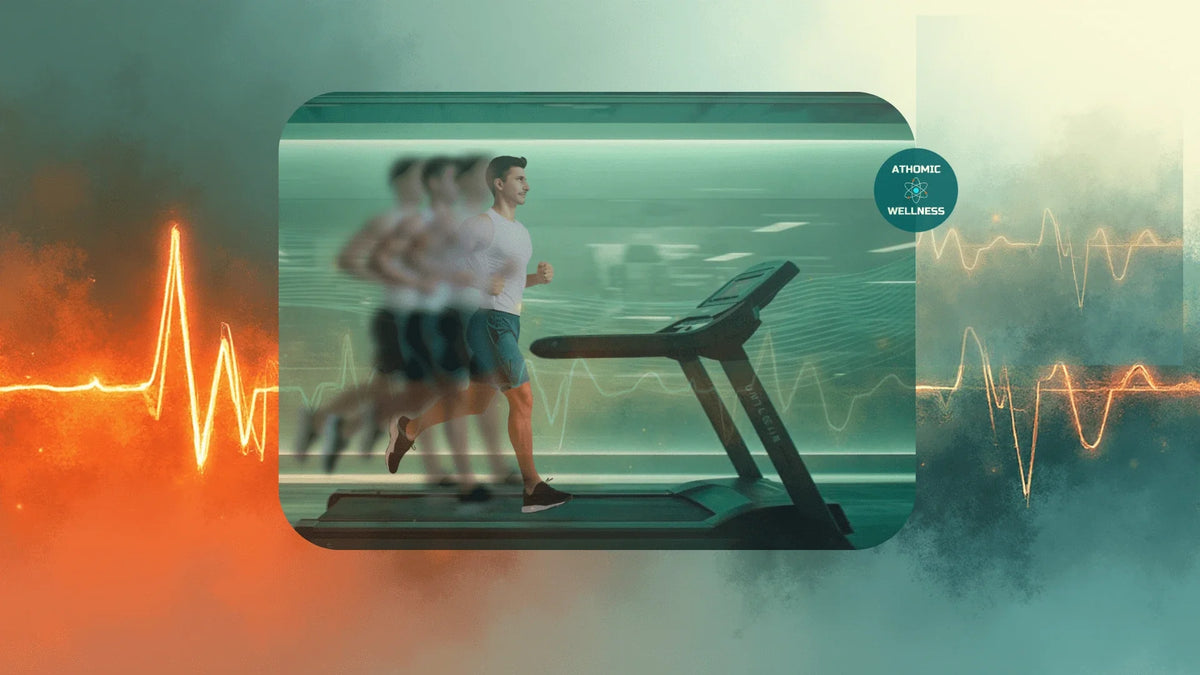
🫀 Endurance & heart: Do you have to choose between High-Intensity Interval Training (HIIT) vs. Moderate-Intensity Continuous Training (MICT)?
|
|
Time to read 5 min
Home services - Geneva
Shop / Boutique
Wear / Vêtements
Athomic Essentials
|
|
Time to read 5 min
You're recovering from a cardiac event, or you simply want to put your heart back in the game.
And immediately, the big question arises: should you play it safe with moderate-intensity continuous training (MICT), or pick up the pace with the famous HIIT (High-Intensity Interval Training)?
Opinions clash:
"HIIT? Too brutal for the heart!" — "Continuous? Too soft, you'll fall asleep!"
The truth? Your heart doesn't need a side, but a tempo.
Recent research in cardiovascular rehabilitation shows that combining both leads to faster, more stable, and more lasting progress (Wang et al., 2022; McGregor et al., 2023; Ingle et al., 2024).
And don't panic: we're going to decode all of this without jargon, without an ECG in hand — just with a bit of science, common sense, and a lot of heart.
HIIT (High-Intensity Interval Training) alternates short, intense effort phases (generally between 85% and 95% of maximum heart rate) with active recovery phases.
It's a method used in cardiovascular rehabilitation to boost cardiorespiratory capacity, improve exercise tolerance, and stimulate the heart's adaptation mechanisms.
"HIIT is like an espresso for your heart: short, intense, and effective - as long as you don't drink six in a row.
Studies agree: HIIT more quickly improves the heart's ability to use oxygen (Wang et al., 2022).
A significant increase in VO₂max and cardiac contraction force is observed after only eight weeks of HIIT cardiovascular rehabilitation, provided it's rigorously supervised.
In other words: the heart becomes more elastic, more responsive, without increased risk.
VO₂max (Maximal Oxygen Volume) refers to the maximum amount of oxygen your body can use during intense effort.
The higher it is, the better your heart, lungs, and muscles are at taking in, transporting, and consuming oxygen efficiently.
It's your aerobic power index: the ultimate measure of your endurance.
In short: HIIT improves your VO₂max, while MICT stabilizes it and makes it sustainable.
Together, they transform your heart into a hybrid engine — capable of strong acceleration without overheating.
The benefits of HIIT have been widely demonstrated: improved cardiac perfusion, insulin sensitivity, and parasympathetic recovery (McGregor, 2023; Ingle, 2024).
But Taylor (2020) notes: in the long term, the differences fade – regularity remains key.
💬 Athomic Translation: HIIT is the bird's eye chili of cardio.
A little wakes up your system, too much burns your tongue... and your fibers.
MICT is the art of rhythm.
At 65–75% of your max heart rate, you grow your engine without overworking it.
Your stroke volume increases, your breathing becomes more efficient, and your heart learns patience.
In continuous endurance:
capillaries multiply,
circulation improves,
resting heart rate decreases,
heart rate variability increases.
In short, your heart becomes more efficient: an electric motor that runs smoothly.
📖 According to Cattadori et al. (2023) and Cazorla & Léger (2004), continuous training develops the essential aerobic base for heart health: it stabilizes the engine before adding power.
HIIT acts as an accelerator: it stimulates maximum power, oxygen consumption, and tolerance to metabolic stress (Wang 2022; McGregor 2023).
HIIT builds responsiveness: it teaches the heart to adapt to stress and manage turbulence (Gillen & Gibala, 2021).
But without the aerobic foundation of MICT, power remains unstable: the engine runs high, but without fuel to last.
MICT, meanwhile, expands the base: it develops mitochondria, improves muscle perfusion, and strengthens heart rate variability (Cazorla & Léger, 2004).
Thanks to it, the heart becomes elastic: it handles intensity peaks better, recovers faster, and intelligently manages increased rhythm.
In reality, HIIT and MICT are the two beats of the same heart:
one creates the pulse, the other ensures its stability.
It is their dialogue, not their duel, that builds lasting endurance — one that does not seek immediate performance, but the longevity of movement.
Mitochondria, these tiny energy powerhouses, are the heart's true engine.
They convert oxygen into ATP and multiply thanks to continuous training (Cazorla & Léger, 2004).
Each MICT session strengthens their efficiency: more mitochondria = more energy autonomy.
Without them, HIIT becomes a flash in the pan.
Without an MICT base, HIIT is like a Formula 1 engine on a stationary bike: spectacular, loud, exhilarating... but not designed to go the distance.
Good continuous training improves muscle capillarization, oxidative recovery, and the conversion of lactate into useful energy.
It is this foundational work that makes HIIT cardiovascular rehabilitation sessions truly effective.
Glycogen is your primary reservoir, phosphocreatine your accelerator.
But without a solid aerobic foundation, energy regeneration is incomplete.
The result: your body gets winded quickly, your recovery slows, and fatigue sets in sooner.
Research (Wang et al., 2022; McGregor et al., 2023) shows that MICT improves the efficiency of oxidative metabolism:
better oxygenation, better lactate reuse, and, most importantly, faster recovery after exercise.
The body then becomes capable of powering through for longer, without overheating.
💚 A well-trained heart knows how to endure, recover, and perform without burning out.
This is the physiological intelligence we call sustainable endurance: the Athomic hallmark.
At the University Hospitals of Geneva, the EURECA (Ensemble Unis pour la REudaction CArdiovasculaire) program brings together patients, physiotherapists, and coaches to relearn how to move with confidence.
A human, scientific, and collective approach – everything we love at Athomic Wellness.
Under the coach's or physio's watchful eye, every heartbeat becomes data — and every effort, a renewed sense of confidence.
The objective? To restore physical condition while promoting safety and the pleasure of movement.
This is the continuity of rehabilitation: moving from hospital protocol to active life, without skipping steps.
The program, certified by Fitness Guide, embodies the balanced HIIT + MICT philosophy:
a foundation of gentle endurance, punctuated by more dynamic sequences adapted to each individual.
In short, an intelligent transition between clinic and field, perfectly aligned with the Athomic vision: movement as medicine.
HIIT and MICT are not opposed: they are united.
One teaches you to react, the other teaches you to endure.
One stimulates power, the other structures stability.
Mitochondria become your internal batteries, VO₂max your progress indicator, and your regularity the key to longevity.
The human heart is not a racing machine; it is an adaptation powerhouse: it learns, regenerates, optimizes.
In Geneva, the EURECA program proves it: cardiac rehabilitation can be scientific, supervised… and joyfully human.
What if the future of health was this: hybrid hearts, trained with measure and boldness?
Can I start directly with HIIT?
👉 Not without medical validation. First, build three to four weeks of endurance.
How many sessions per week?
👉 Three minimum, four to five ideally, alternating intensities.
What if I feel tired?
👉 Lower the intensity, not the regularity.
Should I monitor my heart rate?
👉 Yes, but without obsession: combine heart rate, breathing, and perceived exertion.
When will I see results?
👉 On average: 4 to 6 weeks for fitness, 8 to 12 for real changes.
Author: Julien Schaeffer
A physical trainer and health coach in Geneva, Julien combines movement science with a human approach. Passionate about sustainable performance, he helps everyone transform training into a health tool — measured, consistent, and vibrant.

Coaching without commitment

99% of our customers are satisfied

100% payment secure CB, PayPal

Our team is at your listening
Coaching without commitment
99% of our customers are satisfied
100% payment secure CB, PayPal
Our team is at your listening

Athomic Wellness - You too, be part of the solution
Athomic Wellness - You too, be part of the solution
Athomic Wellness - You too, be part of the solution
Athomic Wellness - You too, be part of the solution
Athomic Wellness - You too, be part of the solution
Athomic Wellness - You too, be part of the solution
Athomic Wellness - You too, be part of the solution
Athomic Wellness - You too, be part of the solution
Athomic Wellness - You too, be part of the solution


