


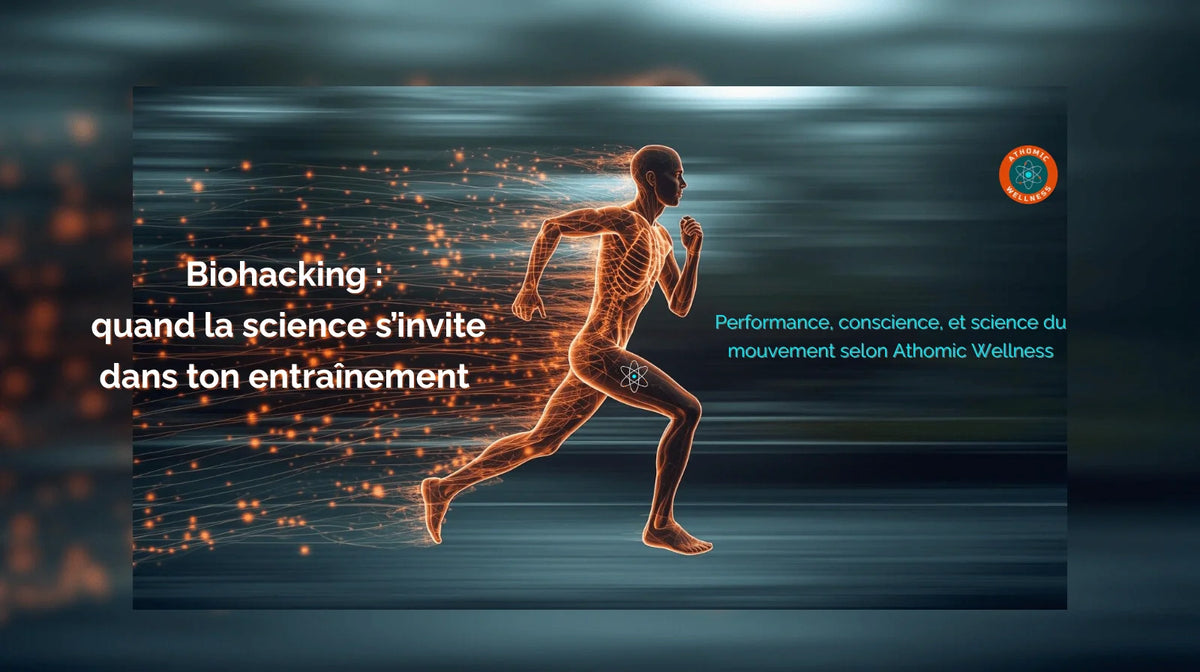
Biohacking: when science takes over your workout. From Silicon Valley to conscious muscle
|
|
Time to read 5 min
Home services - Geneva
Shop / Boutique
Wear / Vêtements
Athomic Essentials
|
|
Time to read 5 min
Biohacking is where life science meets movement awareness.
Behind this often-misused word lies a simple idea: improve performance without breaking yourself.
Not by adding more technology, but by combining data, feeling, and regeneration.
But one question remains:
👉 How far can we optimize the body without betraying its nature?
👉 And how can technological progress become an ally—without us becoming its product?
Welcome to applied body science according to Athomic Wellness, where we explore how biohacking training connects science, measurement, awareness, and movement without opposing them.
A journey between genius garages, Silicon Valley, and very real bodies, to understand how to "hack your performance without hacking your health."
In the late 1980s, in a few American garages cluttered with oscilloscopes and second-hand microscopes, a crazy idea emerged:
What if we could hack biology the way we hack a computer program?
The word biohacking comes from the fusion of bio (life) and hacking (creative circumvention, ingenious optimization).
We also speak of DIY biology, or, more charmingly, do-it-herself biology.
These pioneers—engineers, artists, independent researchers—dreamed of a free and open-source science, where everyone becomes an actor in their own biological evolution.
In the 2000s, biohacking left the garages to enter the glass-walled offices of Silicon Valley.
Over-caffeinated brains—including Dave Asprey, future creator of Bulletproof Coffee—applied the hacking mindset to the human itself.
During a trip to Tibet, Asprey discovered that monks drank yak butter tea to stay lucid at high altitudes.
Back in California, he adapted the idea: coffee mixed with clarified butter and MCT oil, supposedly stabilizing energy and concentration—closer to a metabolic experiment than a simple espresso.
His mantra: modify your internal and external environment to control your biology.
In other words: become the coder of your own body.
But behind this quest for longevity lies a more essential idea: regaining control over life.
Biohacking is not an escape to technology: it is a conscious exploration of what our biology can become when we listen to it as much as we measure it.
💬 At Athomic Wellness, we sum it up like this: "Hack your performance, without hacking your health."
📚 To go further:
➡️ Biohacking: The Science of Optimizing the Human Body — David Sandua
Before smartwatches and wellness apps, early biohackers dismantled medical sensors and shared their results on confidential forums.
From these experiments emerged the Quantified Self movement, founded by Kevin Kelly and Gary Wolf in the mid-2000s:
" What gets measured gets improved. "
Sleep, heart rate, stress, nutrition: everything becomes data, everything becomes adjustable.
The 2010s saw an explosion of health wearables—watches, rings, scales, and skin sensors—which popularized physiological measurement.
With a simple gesture, everyone can now access data once reserved for laboratories:
Heart Rate Variability (HRV)
Skin Temperature
Sleep Quality
Metabolic Stress
Oxygen Saturation (SpO₂)
This data now forms the foundation of biohacking based on science, not belief.
It allows us to understand how the body reacts, recovers, and adapts to training—a silent revolution that brings research and practice closer.
Biohacking training connects physiological data with body awareness, to better understand one's own thresholds for effort and recovery.
Sports physiology has profoundly evolved thanks to these new tools.
The work of Shaffer & Ginsberg (2017) established the basis for interpreting Heart Rate Variability (HRV), a key indicator of recovery and stress adaptation capacity.
The higher the HRV, the more flexible and reactive your autonomic nervous system is—a sign of balance between performance and regeneration.
Neuroscience also confirms the importance of light, sleep, and circadian rhythm in hormonal and nervous regulation.
➡️ Using Light for Health — Huberman Lab (Stanford University)
Thus, biohacking applied to sports becomes a science of the conscious body, where technology and intuition finally dialogue.
The tool measures, but it is the body that interprets.
In biohacking training, each indicator—heart rate, sleep, stress—becomes a language that one learns to interpret rather than endure.
Data tells only part of the story: that of the measured body.
But there is another, more subtle language, that of the felt body.
Because sometimes, sensors can disrupt our inner listening: we end up running to stay "in the zone" rather than to feel our rhythm.
In training, for example, heart rate monitors allow us to identify heart rate zones and ventilatory thresholds.
But an athlete who knows themselves often knows, thanks to their respiratory rate and intensity and their ability to speak or not during effort, which zone they are in—without needing to look at their wrist.
This is the nuance of conscious biohacking:
measure to understand, but feel to adjust.
Technology then becomes a compass, not a leash.
It indicates the course, but the body remains captain.
Biohacking training does not oppose sensor and sensation: it brings them into dialogue. Data guides, the body adjusts.
" Data illuminates the path, sensation traces the way. "
Modern sports biohacking extends conscious physical preparation.
Data does not replace expertise: it refines it.
Applying biohacking training to physical preparation means giving new meaning to technology: understanding, regulating, then letting the body do its work.
HRV watches & heart rate sensors → measure internal stress and adjust load
Sleep analysis: Oura, Whoop, Suunto Race, Sleep Analyzer Withings
Withings U-Scan Nutrio urine sensors → nutritional monitoring and hydration (official source)
Breathing & heart rate coherence: guided applications based on HRV
Data should remain a tool for awareness, not control.
This is where Athomic coaching comes in: observing training load, listening to internal signals, adjusting before correcting.
Tim Gabbett’s (2016) research on load management illustrates this approach: gradual progression both protects and develops.
The future of coaching?
Personalized plans, calibrated to your biological rhythm and adjusted to your current HRV index.
After the era of "all data" comes the era of balance.
Sustainable performance will depend on the ability to reintegrate life: light, natural cycles, silence, and breathing.
The biohacking of the future will not be more connected, but more coherent.
Technology will become transparent, serving presence.
Between nature and data, movement remains the best measure.
How far can the body be optimized without betraying its nature?
The answer is probably found between two heartbeats: that of data and that of life.
Because measuring is understanding—but feeling is knowing.
Biohacking training, as conceived at Athomic Wellness, is not a race for augmentation,
it is an education of feeling supported by scientific rigor.
Technology plays its role: observing, alerting, guiding.
But it is always the body that provides the truth on the ground.
Progress then becomes a silent ally, an extension of consciousness.
It is no longer the machine that directs, but the human who learns to dialogue with it.
A subtle alliance where performance is evaluated as much by lucidity as by resilience.
Hacking one's performance without hacking one's health means choosing to stay alive in the age of data.
Sandua, D. (2024). Biohacking: The Science of Optimizing the Human Body.
Shaffer & Ginsberg (2017). An Overview of Heart Rate Variability Metrics and Norms – Frontiers in Public Health
Gabbett (2016). Load Management in Training and Sport – British Journal of Sports Medicine
Huberman Lab (Stanford University). Using Light for Health
Author: Julien Schaeffer
Founder of Athomic Wellness, a certified physical trainer and passionate about biohacking, sports physiology, and applied neurosciences.
For over ten years, he has been exploring how technology, the science of movement, and nature can coexist without opposition.
Between Geneva and the natural world, he designs training as a laboratory for balance: measuring, understanding, but above all, feeling.
Stay conscious, move Athomic.
Add a touch of energy and serenity to your daily life.
Anchor your energy, atomize your limits.
Every detail counts for progress: discover our essentials.

Coaching without commitment

99% of our customers are satisfied

100% payment secure CB, PayPal

Our team is at your listening
Coaching without commitment
99% of our customers are satisfied
100% payment secure CB, PayPal
Our team is at your listening

Athomic Wellness - You too, be part of the solution
Athomic Wellness - You too, be part of the solution
Athomic Wellness - You too, be part of the solution
Athomic Wellness - You too, be part of the solution
Athomic Wellness - You too, be part of the solution
Athomic Wellness - You too, be part of the solution
Athomic Wellness - You too, be part of the solution
Athomic Wellness - You too, be part of the solution
Athomic Wellness - You too, be part of the solution


